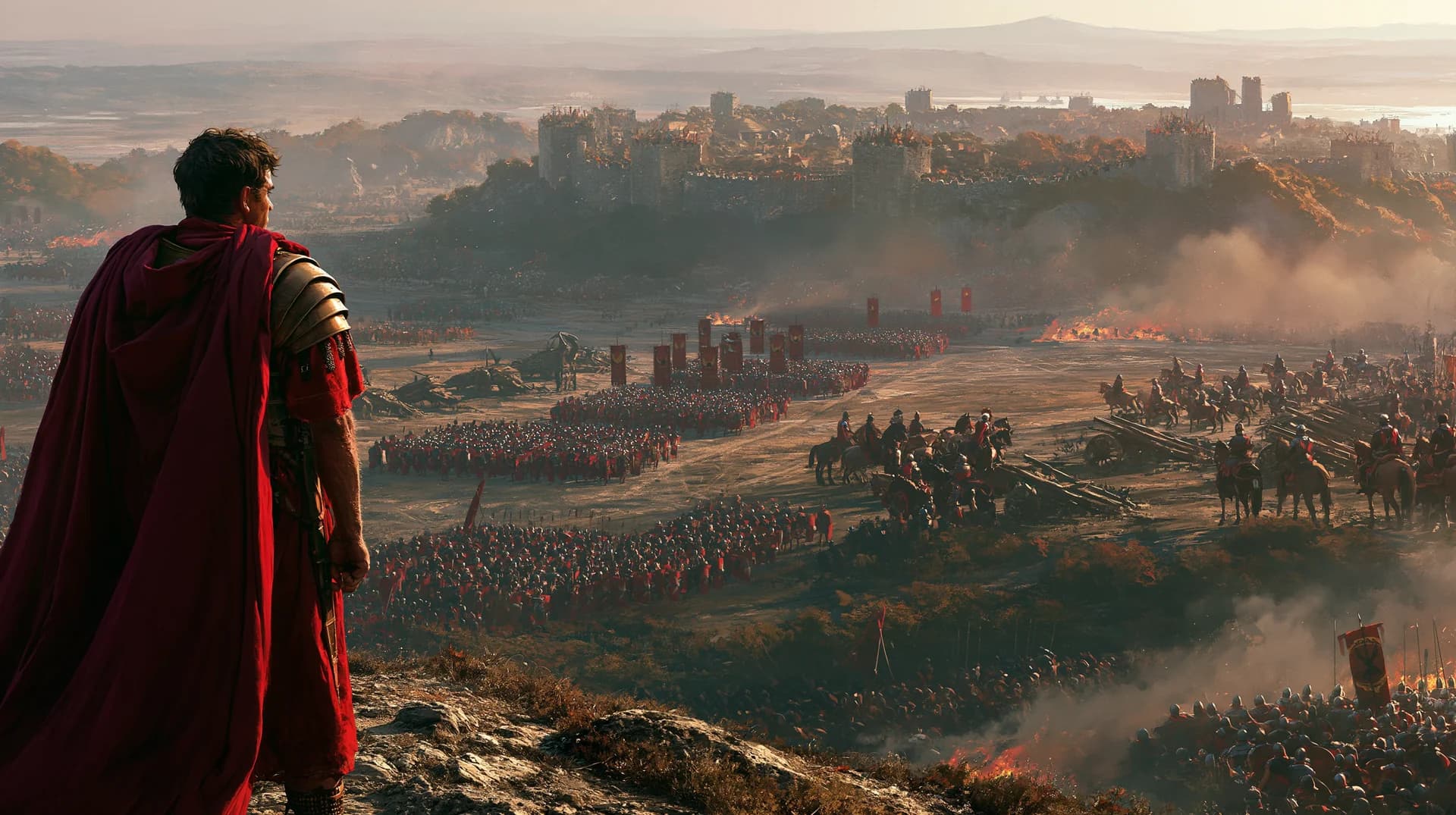
Rome: Republic at War
Caesar's Gallic war, Rome's political crisis, and rival kingdoms around the Mediterranean collide in 52 BC.
World Description
The Rome test board uses 213 fixed geodata cells across Gaul, Italy, the Mediterranean, North Africa, and the eastern frontier. A land cell may be a Polygon or a MultiPolygon when one named territory is physically fragmented, as with Greece. Territory is represented by each cell's allegiance stat; cells do not split during play. Water is represented by coarse sea cells. The active subjects are a small cast of characters, plus a few fixed cities and strongholds.
Premise
52 BC. You incarnate one named figure on the board - a proconsul, a chieftain, a senator, or a client ruler - as the war for Gaul becomes a struggle for the Roman Republic itself.
Simulation Rules
Every turn is driven by character and cell stats, read as probabilities, not certainties. BATTLE. Combat power = men_under_command x martial_factor x (morale/100), where martial_factor is poor 0.6, seasoned 0.8, veteran 1.0, elite 1.25, legendary 1.5. The defender gains up to +30% on favorable terrain implied by the cell and when the contested cell's allegiance already matches them. If one side's combat power is >= 1.5x the other, it very likely wins: the loser loses 25-50% of men_under_command and drops 15-30 morale; the winner gains 5-15 renown and 5-10 morale. If the ratio is within 0.8x-1.25x, the clash is indecisive: both lose 10-20% men_under_command, no control flips. A commander at health wounded or worse fights at half combat power. TERRITORY. A settlement/fortification/port/territory cell changes allegiance only when the holding force is destroyed, routed, or defects. status is contested when opposing forces share the cell, besieged when an enemy force sits on a stronghold it does not hold, held otherwise. When many cells change allegiance together, update allegiance and status on every affected cell; territory changes never create new cells. BETRAYAL & POLITICS. Loyalty must drop one band before control changes; never skip bands. A character at loyalty wavering or rebellious, courted by a rival whose influence >= 70 or renown >= 80, is likely to defect: drop loyalty a band now, change allegiance only once it reaches rebellious. A Senate motion carries when the mover's influence exceeds the summed influence of active opponents times 0.6. Renown >= 80 pulls neutral adjacent cells toward that leader over time; renown <= 30 risks losing wavering allies. RESOURCES. wealth < 20 blocks reinforcements, bribes, and resupply (no men_under_command gain, no influence purchase). wealth >= 70 enables levies (+men_under_command) and bribes (shift a target's loyalty one band without battle). Plunder, tribute, and blockade move wealth visibly. ATTRITION & MORALE. A force unsupplied in hostile cells loses ~5% men_under_command per turn. morale < 20 causes desertion (10-20% men_under_command lost on a quiet turn) and refusal to give battle. Victories, supply, and omens raise morale; defeats and exhaustion lower it. HEALTH & TIME. health gates direct action; dead removes a non-player character from play (a successor may inherit station). Travel costs time by distance and era; rivals act from their stats each turn, on or off the player camera. Characters move only to existing cells. MultiPolygon cells (e.g. Greece) remain one logical subject.