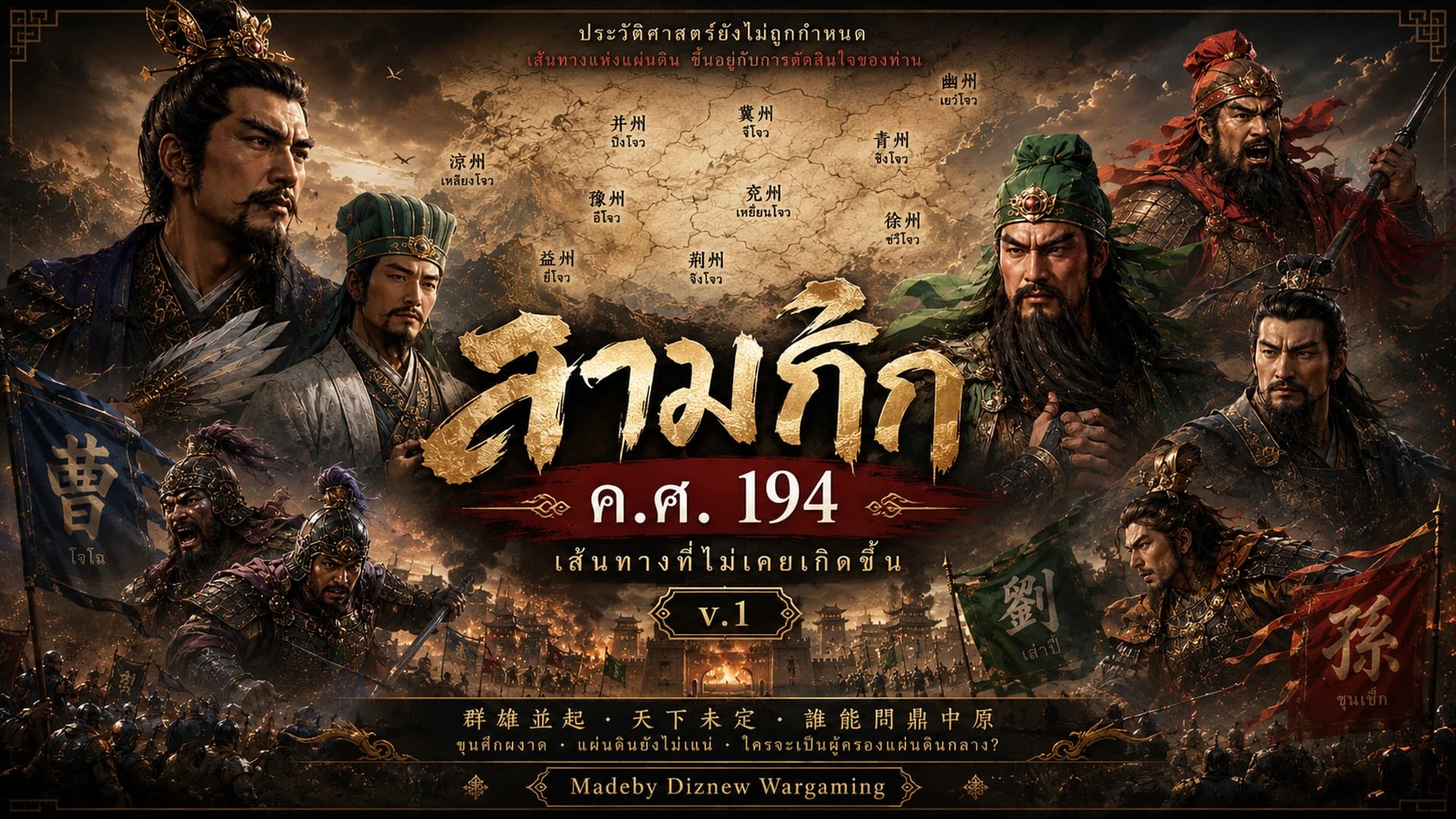
Three Kingdoms AD 194 — Paths Never Taken 1.1
The late Han Dynasty landscape begins to fracture into competing powers, and history after January 1, 194, is completely open to change.
- 11
- Games
- 94
- Turns
- 4
- Upvotes
Characters
World Map
Your world takes shapeThe first horizons are coming into view.
World Description
This simulation covers China and its surrounding regions on the provided map, with the axes of politics and warfare situated in Northern China, Central China, Jing Province, Sichuan, Gansu, and the Liaodong frontier. Areas outside the Chinese theater are treated as static geographical settings and are not simulated as major factions.
Premise
On January 1, 194 AD, Emperor Xian remains the symbolic center of legitimacy for the Eastern Han Dynasty, but real control is scattered among various warlords, governors, and private armies. Cao Cao, Yuan Shao, Yuan Shu, Gongsun Zan, Tao Qian, Liu Biao, Liu Yan, Li Jue, and other power players are consolidating their strength in a world where Wei, Shu, and Wu do not yet formally exist.
Simulation Rules
ระบบควรให้ความสำคัญกับสายบังคับบัญชา เสบียง และความภักดีของขุนพลสำคัญ ขุนพลที่มี bond แบบพี่น้องร่วมสาบานหรือสายเลือดควรต้านทานการแตกฝ่ายได้ดีกว่า ความสัมพันธ์แบบพันธมิตรทางการเมืองสามารถเสื่อมสลายเมื่อผลประโยชน์เปลี่ยน ความทะเยอทะยาน บุคลิกภาพ และการประสานงานของขุนพลสำคัญควรส่งผลต่อการรับคำสั่งและโอกาสเปลี่ยนฝ่าย เมื่อสงครามยืดเยื้อหรือขุนพลสำคัญสูญเสีย อำนาจในพื้นที่สามารถเปิดทางให้เกิดขุนพลหรือกุนซือสมมุติหน้าใหม่จากตระกูลทหารท้องถิ่น นักปราชญ์ นายกอง และผู้แปรพักตร์ โดยให้ตัวละครความสามารถสูงเกิดขึ้นได้ยากและไม่สร้างอนาคตตามประวัติศาสตร์แบบตายตัว