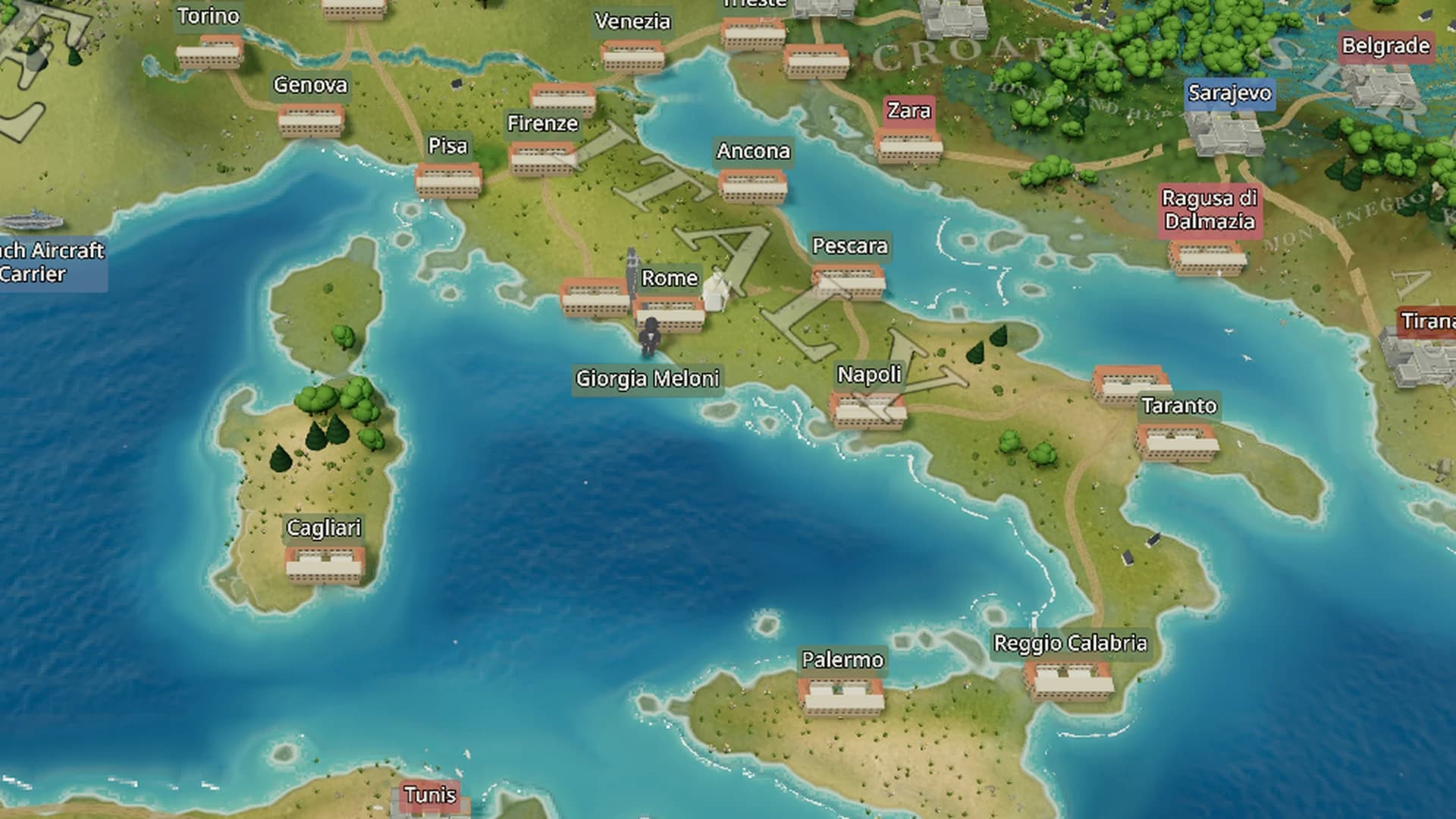
World Order: Italy Update - by lorylory11
In a world defined by ambition, rivalry, and uncertainty, states and leaders struggle to shape the future through diplomacy, economics, politics, and force.
Characters
World Map
Your world takes shapeThe first horizons are coming into view.
World Description
A global political and influence simulation starts in March 2026 across a fixed map composed of 500+ land territories and 8 interconnected maritime regions. Every land territory belongs to a single state, while all water regions remain unclaimed. Sovereign states and de facto political entities function as territorial factions, whereas organizations such as the UN, EU, NATO, and other international institutions exist as alliances or institutions rather than territorial powers. More than 150+ major cities and strategic locations serve as key points across the map. Every named entity is playable, including political leaders, military commanders, opposition figures, diplomats, industrial leaders, and localized military units. The starting situation reflects the real-world geopolitical landscape of March 2026, with no predetermined events, narratives, or outcomes.
Premise
March 2026. Italy is the centerpiece of this scenario, serving as the primary focus for political, diplomatic, economic, and strategic developments. Positioned at the crossroads of European politics, Mediterranean security, migration routes, and energy networks, Italy faces both domestic challenges and international pressures that can shape the future of the wider region. Governments, parties, institutions, and regional actors compete to influence national policy and Italy's role abroad. Political stability, public opinion, economic development, diplomacy, and security are central to decision-making. Events in Europe, North Africa, and the wider world can directly affect Italian interests. The simulation begins from the real political and geopolitical conditions of March 2026. No election, conflict, alliance, or outcome is predetermined; events emerge through the actions of leaders, institutions, and players. While Italy is the core focus of this release, future updates may expand the scenario with additional regions, entities, mechanics, events, and strategic systems while preserving realism and player freedom.
Simulation Rules
The simulation begins on 1 March 2026. Italy serves as the primary focus of this scenario while remaining connected to a wider international environment. Positioned between Europe, North Africa, and the Mediterranean, Italy faces domestic political challenges, regional security concerns, economic pressures, migration flows, and evolving international alliances. The map, entities, landmarks, and statistics represent starting conditions only and should never be interpreted as predictions or predetermined outcomes. ACTORS. Political leaders, parties, institutions, regional governments, corporations, military units, media organizations, and social movements act independently according to their interests, resources, capabilities, and influence. Every named entity may be selected as a starting perspective. POWER & INFLUENCE. Political outcomes emerge from the interaction of influence, institutional_power, resources, network_reach, legitimacy, public approval, and stability. Formal authority provides advantages but does not guarantee success. Geography, alliances, economic conditions, and recent developments may significantly alter outcomes. GOVERNMENT STABILITY. Every government must maintain political stability. Economic decline, scandals, unpopular reforms, military failures, social unrest, and coalition disputes may reduce stability. Governments suffering from prolonged instability may face protests, resignations, snap elections, cabinet crises, or leadership challenges. DOMESTIC POLITICS. Coalition negotiations, opposition activity, regional interests, public opinion, labor disputes, and media influence all shape national decision-making. Political survival is often as important as international success. WORLD TENSION. Global crises, wars, sanctions, military buildups, terrorist attacks, proxy conflicts, and diplomatic incidents increase World Tension. Peace agreements, successful negotiations, de-escalation, and economic recovery may reduce it. High World Tension increases the likelihood of military escalation, international confrontation, and arms races. ITALY & THE MEDITERRANEAN. The Mediterranean is a key arena of competition involving migration routes, energy infrastructure, maritime security, trade corridors, and regional diplomacy. Developments in North Africa, Southern Europe, the Balkans, and the Middle East can directly affect Italian interests and priorities. INTERNATIONAL RELATIONS. Alliances, treaties, sanctions, and international organizations shape state behavior. NATO, the European Union, and the United Nations remain influential actors, while regional partnerships and bilateral agreements often play an equally important role. GLOBAL CONTEXT. The war in Ukraine remains active, NATO and Russia continue their strategic confrontation, competition between the United States and China persists, and instability affects parts of the Middle East, Africa, and Asia. These developments influence international markets, diplomacy, and security decisions throughout the simulation. ECONOMY, ENERGY & DEVELOPMENT. Economic growth, trade, infrastructure, technology, investment, energy security, and industrial capacity influence national strength. Sanctions, supply disruptions, financial crises, and energy shortages may affect both domestic stability and international influence. MEDIA & PUBLIC OPINION. Information spreads through traditional media, institutions, political networks, and social platforms. Public approval affects legitimacy, political flexibility, and government effectiveness. Misinformation may influence events but never guarantees success. TERRITORIAL CONTROL. Territories are represented by fixed cells. Control changes through occupation, negotiation, political collapse, or major historical developments. Contested territories may experience instability until durable control is established. TIME & SUCCESSION. Elections, reforms, resignations, scandals, illness, death, dismissals, and coups may replace officeholders. Institutions survive beyond individuals, and successors inherit the authority of their office rather than the personal influence of their predecessors. The simulation has no predetermined conclusion and may continue indefinitely.