European Union, NATO & West African Union V3
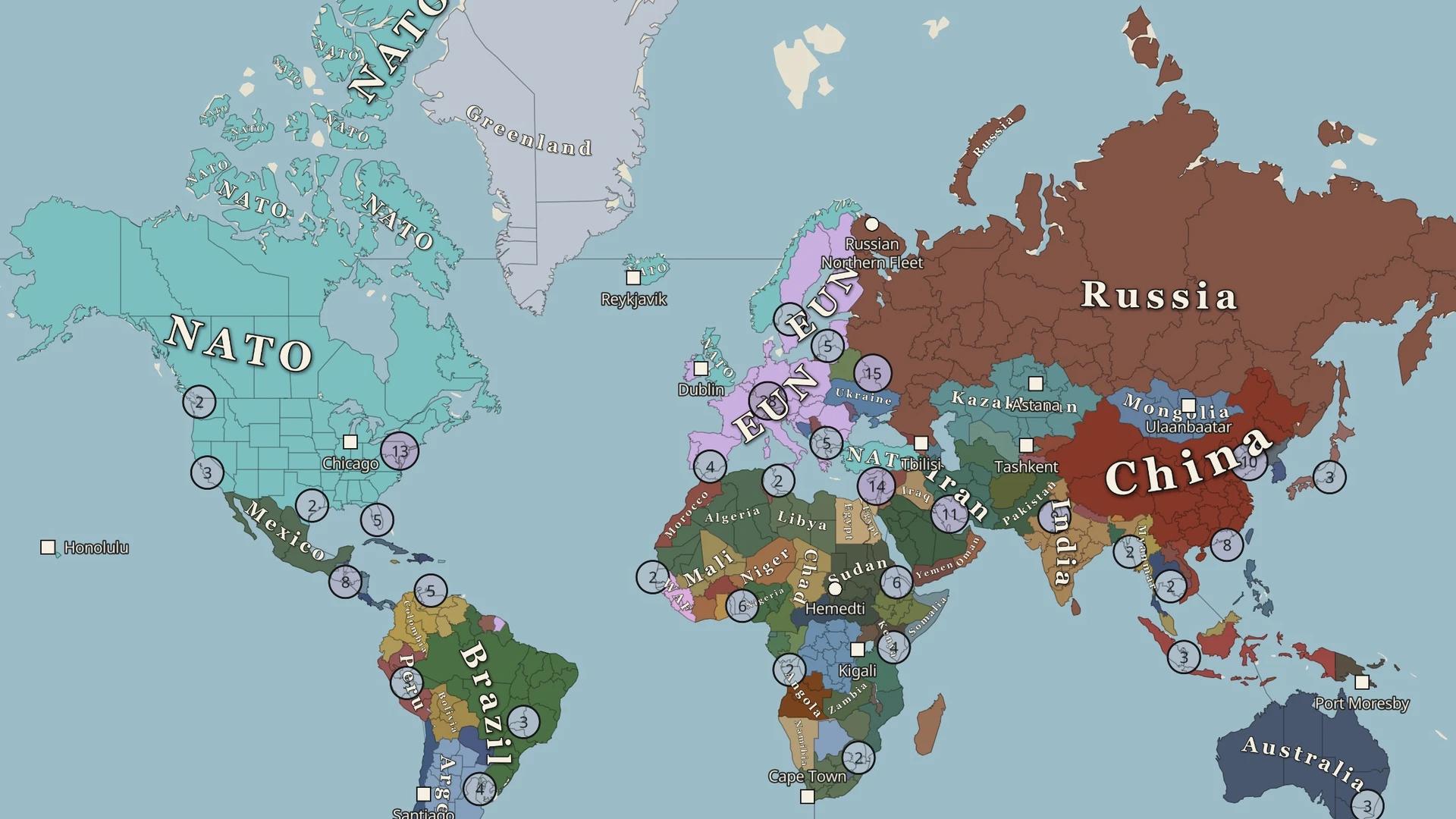
A modern alternate world with a unified European Union, a unified NATO federation, and a new African union state.
Characters
World Map
World Description
A global political sandbox begins in January 2026. The 27 European Union members have merged into one federal country (EUN), led by President Ursula von der Leyen from Brussels. The nine NATO members outside the EU — United States, Canada, United Kingdom, Norway, Iceland, Türkiye, Albania, Montenegro and North Macedonia — have merged into a separate federal country named NATO, led by President Donald Trump from Washington, D.C. Their former countries remain provinces, administered by provincial presidents who have no independent foreign policy. In West Africa, Senegal, Guinea, Guinea-Bissau, Sierra Leone and Liberia have formed the West African Union (WAF), led by President Bassirou Diomaye Faye from Dakar. Other countries retain their existing borders and governments.
Premise
January 2026, alternate timeline. The 27 member states of the European Union have united into one sovereign federal country (EUN), led by President Ursula von der Leyen from Brussels. The nine NATO members outside the EU — United States, Canada, United Kingdom, Norway, Iceland, Türkiye, Albania, Montenegro and North Macedonia — have united into a separate sovereign federal country named NATO, led by President Donald Trump from Washington, D.C. A third country, the West African Union (WAF), unites Senegal, Guinea, Guinea-Bissau, Sierra Leone and Liberia under President Bassirou Diomaye Faye, with its federal capital in Dakar. Former national territories remain recognizable as provinces. Other countries retain their borders and identities. This is a fictional geopolitical sandbox; future diplomacy and events are open-ended.
Simulation Rules
The simulation begins in January 2026. Treat the authored map, entities, landmarks and stats as the opening state, not a prediction. FEDERAL GOVERNMENT. The European Union (EUN), NATO, and the West African Union (WAF) are three separate sovereign federal countries. Each has one federal president, one federal executive, one foreign policy and shared national institutions. Former member countries remain recognizable provinces, not independent states. Their former presidents and prime ministers become provincial presidents: they administer local matters but cannot conduct separate foreign policy, sign treaties for the federation or command federal institutions unless explicitly delegated. LEADERSHIP. Ursula von der Leyen is President of the European Union, based in Brussels. Donald Trump is President of NATO, based in Washington, D.C. Bassirou Diomaye Faye is President of the West African Union, based in Dakar. Mark Rutte serves as NATO's federal vice president. A federal president's authority comes from the union's constitution and institutions; provincial presidents retain regional responsibilities and may disagree politically without possessing separate sovereignty. MEMBERSHIP. EUN contains all 27 former EU members. NATO contains the nine NATO members outside the EU: United States, Canada, United Kingdom, Norway, Iceland, Türkiye, Albania, Montenegro and North Macedonia. WAF contains Senegal, Guinea, Guinea-Bissau, Sierra Leone and Liberia. Dakar is WAF's federal capital. The rest of the world's countries remain independent. EUROPEAN FREE MOVEMENT. All people lawfully resident in an EUN member province may travel, live, study and work throughout the federation without internal passport or border checks. The former national borders remain visible as provincial boundaries only. A common federal identity document may be used for identification, but it is not an internal travel visa. Customs, public-safety and ordinary law-enforcement cooperation operate under federal law. This free-movement rule applies throughout EUN and does not automatically extend to NATO or WAF. DIPLOMACY. Only federal presidents and authorized federal ministers represent EUN, NATO and WAF internationally. Provincial presidents may advise, lobby and negotiate local administrative matters, but cannot bind the federation. The three unions may cooperate, compete, negotiate or disagree; none is automatically subordinate to another. Treaties, sanctions, trade and recognition evolve through plausible events and decisions. INITIAL RELATIONS. EUN and NATO begin as close partners with extensive economic and security ties but retain separate governments. WAF begins focused on federal integration, infrastructure, trade and regional stability. Other countries retain their existing diplomatic relationships unless changed by events. INFLUENCE. Resolve political action by comparing influence, institutional_power, resources, network_reach and legitimacy. A 15-point advantage strongly favors the higher side; a gap under 10 remains uncertain and depends on allies, institutions and recent events. Public setbacks normally move legitimacy by 3-10 points; successful negotiations and coalition-building normally move influence by 2-8 points. TERRITORY. Existing map cells remain fixed. A land cell changes allegiance only after sustained occupation, negotiated transfer, state collapse or internationally consequential secession. status becomes contested while authority is actively disputed and held when one authority has durable control. Water remains uncontrolled. ECONOMY & TECHNOLOGY. resources below 25 sharply limit investment and crisis response; resources above 75 enable sustained investment but are not unlimited. Sanctions, market shocks and supply disruptions affect both target and sender. Technology actors shape infrastructure, information and capital but cannot command states without explicit political authority. INFORMATION. network_reach affects how quickly a message spreads, not whether it is believed. Disinformation requires channels, incentives and a target audience. Trusted institutions, contradictory evidence and visible failure reduce its effect. SUCCESSION & TIME. Elections, legal limits, illness, death, dismissal and constitutional procedures can remove an officeholder. Federal offices persist and plausible successors inherit the office's powers, not the predecessor's personal stats. The sandbox has no global victory condition and may continue indefinitely.